
Somebody tells you San Jose has the best fantasy playoff schedule in hockey.
They are right.
Somebody else tells you San Jose has the worst championship-week schedule in hockey.
Also right.
From March 15 through April 4, the Sharks play 11 games with 7 off-nights. That ranks first in the league.
Move the window to April 5 through April 10 and San Jose plays 2 games with 0 off-nights. Dead last.
Same team. Same NHL schedule. Different fantasy dates.
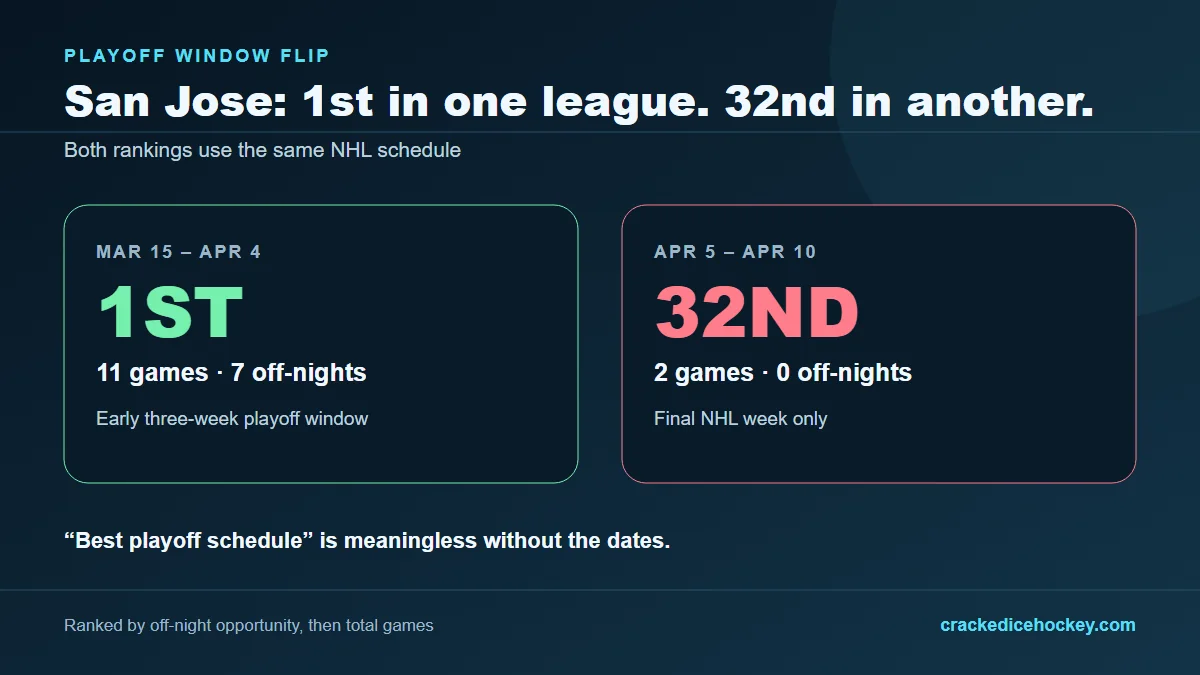
“Best playoff schedule” is an incomplete sentence
A league running March 15 through April 4 is evaluating one three-week window. Shift that window later—to March 22 through April 10—and you remove March 15–21 while adding April 5–10, including a 16-game Saturday. A league using April 5–10 alone is evaluating something else entirely.
Here is what that does to the top of the board:
| Window | Dates | Top schedules by off-night opportunity |
|---|---|---|
| Early three-week playoffs | Mar 15–Apr 4 | SJS 11 GP/7 off; MIN 10/7; WSH 12/6; COL 11/6 |
| Cracked Ice default | Mar 22–Apr 10 | SJS 9/6; DET 10/5; WSH 11/4; BOS 10/4 |
| Final NHL week | Apr 5–Apr 10 | BOS 4/3; DAL 4/3; UTA 4/3; WPG 4/3 |
San Jose is the dramatic flip, but it is not the only one.
Boston ranks 31st in the early window with 9 games and only 1 off-night. In the final NHL week, Boston ranks first with 4 games and 3 off-nights.
Dallas goes from 27th to second. Winnipeg goes from 29th to fourth. Washington moves the other way: third in the early window, 29th in the final week.
That is why calling Washington a playoff target and Utah or Winnipeg an avoid can be perfectly reasonable in one league and completely backward in another.
What this ranking does—and does not—measure
This is a schedule-access ranking. It sorts teams by off-night games first, then total games. An off-night is a date with eight or fewer NHL games.
That matters because a four-game week is not really a four-game week if two of those games land on nights when your starters already fill every active slot.
It is not a ranking of opponent difficulty, projected player production or goalie start quality. Those still matter. Back-to-backs deserve a separate look for goalies in particular; an extra team game does not guarantee an extra start.
The schedule tells me when a player can produce for my lineup. It does not replace the player evaluation.
Why the cutoff matters more than the label
Most preseason schedule articles need one common window so they can publish one common ranking. Fair enough. The problem starts when that ranking reaches your league without the dates attached.
If my league ends April 4, I do not care that Boston plays four more games after that. Those games are real for Boston and worth exactly zero fantasy points to me.
If my league runs through April 10, ignoring those games is just as bad.
This is one of the few schedule settings that can completely reverse a recommendation. I would enter it before fine-tuning scoring weights or arguing over the fifth decimal place of a projection.
How I would use this at the draft
I am not taking a weaker player in September solely because his team has a pretty April. There is a whole regular season to survive first, and hockey has a habit of making six-month role projections look silly.
The playoff window gets louder in three places:
- A keeper or dynasty roster that already has a strong regular-season floor.
- A late-round decision between players in the same tier.
- An in-season trade when making the playoffs is likely and the championship dates are close enough to matter.
Even then, I want the exact window—not a green “good playoffs” badge with no explanation.
The setting to check now
Open your league and find the first and last dates on which fantasy matchups score. Do not assume the NHL regular-season endpoint is your endpoint. Do not assume the default in somebody else’s rankings is your default.
Then rerun the schedule.
San Jose can be first. San Jose can be last. Your calendar decides which answer belongs to you.