Archive note: This is the complete original article, preserved as published for the 2025–26 season. Player teams, roles, eligibility, projections, and schedule conclusions may have changed. Build a current 2026–27 draft board.
Blindsided by the Response
The feedback from my position stacking article hit me like a Jacob Trouba blindside check. I didn't see it coming: people actually building their rosters around the math, asking for more advanced features, demanding a complete draft preparation system. Now I'm flat on my back seeing stars... and lots of pretty colors.
Not the concussion kind of colors, but the kind that represent the next evolution in championship draft preparation. Cyan teams that dominate your playoff weeks. Blue squads that peak when everyone else's rosters crumble. Green workhorses that get you there. And those red disaster schedules you avoid like another Trouba hit to the head.
So while everyone else memorizes ADP rankings, I built something that maps every team's schedule against your league's specific playoff weeks. Position stacking was just the beginning.
Welcome to Zero Bench draft preparation: championship warfare through schedule math.
The Championship-First Philosophy
Zero G from Apples & Ginos changed how we think about goalie value, but there's another Zero concept that's even more important for championships: Zero Bench.
Stop watching your good players ride the pine while inferior options start because of schedule conflicts. Zero Bench drafting minimizes bench conflicts and maximizes games all season long, with special focus on YOUR championship weeks. This approach typically unlocks 15-20 extra games over a season while your opponents debate who to bench.
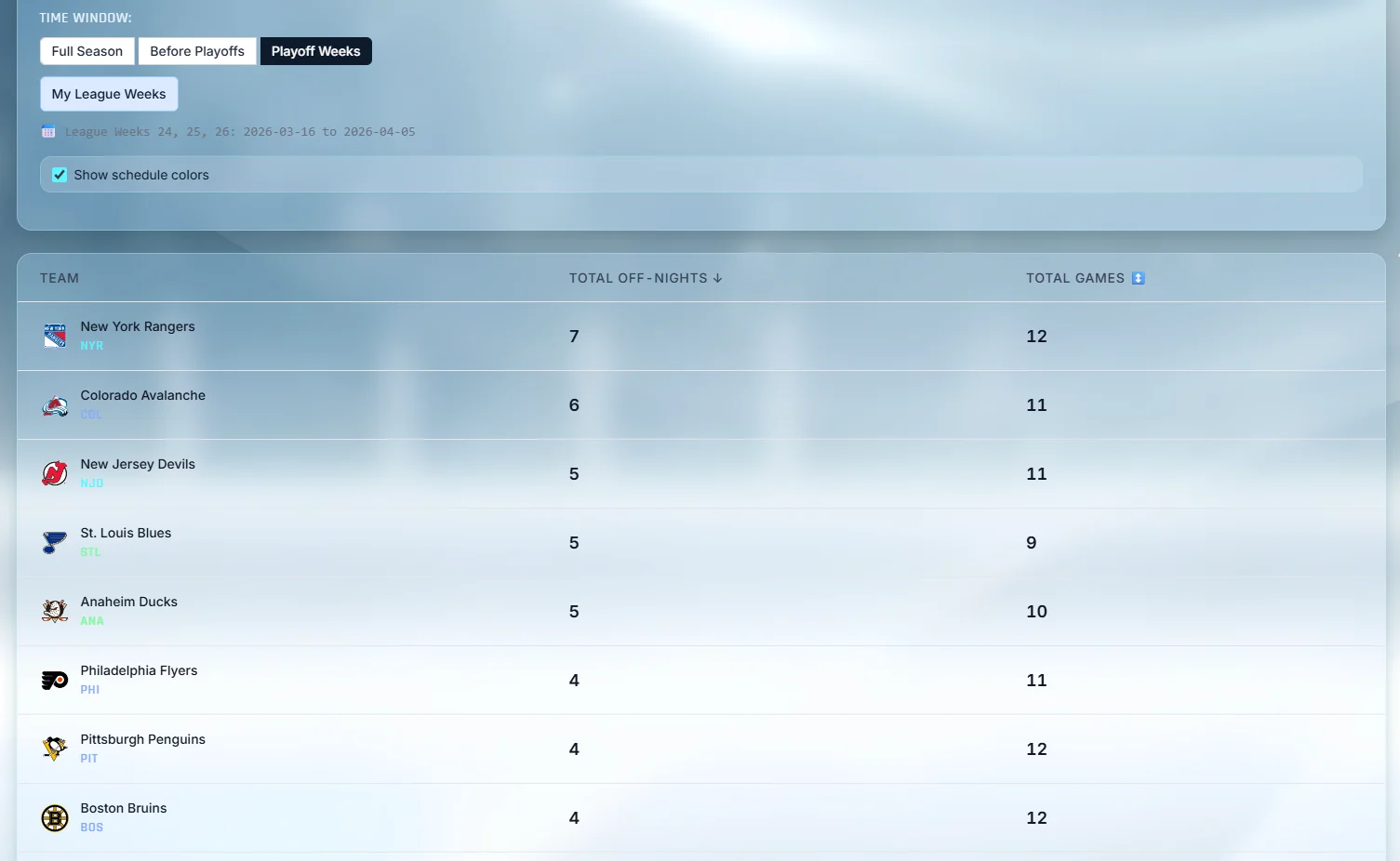
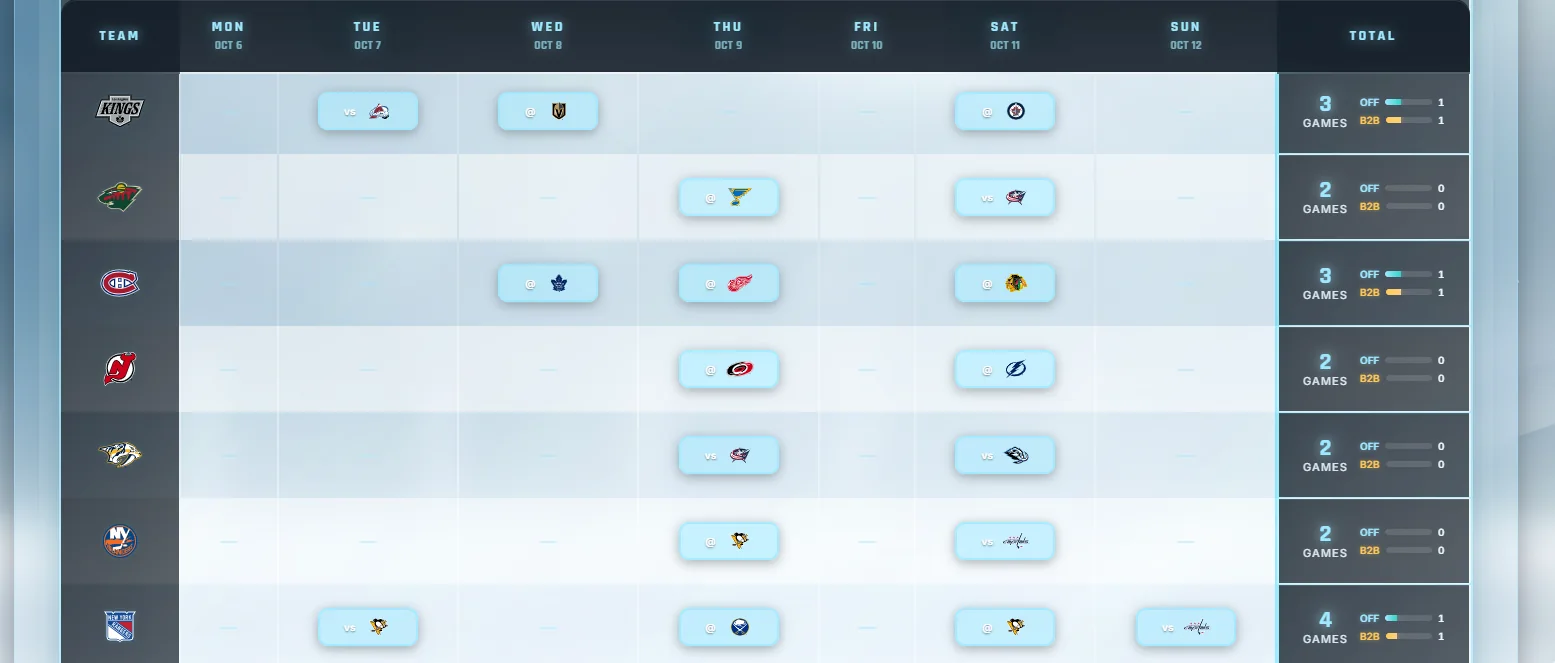
For this mock draft demonstration, I'm using three tools from Cracked Ice Hockey (all completely free): color-coded team tiers that rank schedules for your specific playoff weeks, the complement analysis optimizer that simulates lineup conflicts, and the weekly schedule view that shows streaming opportunities.
The Mock Draft Setup
12-team H2H league, daily lineups, standard points league. Using Apples & Ginos ADP as my baseline (much more realistic than Yahoo's current rankings) but prioritizing schedule math for my league's championship weeks (March 16 - April 5).
I stayed within 10 picks on the back end of A&G's ADP throughout the draft - if I'm picking at 60, I can choose from picks 60-70, letting schedule math determine the final selection within that realistic range.
The Challenge: Can schedule optimization alone build a championship roster, or will ignoring talent rankings completely backfire?
The Zero Bench Draft: Engineering Championships
Rounds 1-5: Elite Talent with Championship Edge
Pick 8: David Pastrnak (RW, BOS) - ADP 8
Perfect ADP value here, but Boston's solid playoff schedule gives him the edge over other elite wingers at this spot. Right wing is thin enough that you need to secure it early, and Pastrnak delivers both talent and championship-friendly timing.
Pick 17: Artemi Panarin (LW, NYR)
Rangers are a Cyan team - everything went wrong for them last season, but they should bounce back hard. Panarin hitting 100 points again with that playoff schedule? That's championship math right there.
Pick 32: Adam Fox (D, NYR) - ADP 35
Same Cyan rationale as Panarin, with slight ADP value as a bonus. Get your stud defenseman early, and when that stud plays for a team optimized for your championship weeks, you've got the perfect combination of talent and schedule.
Pick 41: Elias Pettersson (C/LW, VAN)
Another Cyan team, another bounceback candidate. The C/LW flexibility is bonus value, but the real appeal is Vancouver's championship schedule combined with Pettersson's inevitable return to form.
Pick 56: Thomas Harley (D, DAL)
Here's where Zero Bench thinking starts taking over. Can Harley commandeer that Dallas power play? The upside is massive, and Dallas has elite playoff scheduling. For defensemen, I'm hunting for volume during championship weeks since I'm not rostering five blue-liners.
Rounds 6-11: Where Championships Are Engineered
Pick 65: Nico Hischier (C, NJD)
Cyan team, solid center depth. New Jersey's championship schedule makes Hischier a better pick than his ADP suggests.
Pick 80: Igor Shesterkin (G, NYR)
Triple down on that Cyan Rangers schedule. Shesterkin's due for a bounceback season, and when he's dialed in during your championship weeks, you've got elite goaltending when it matters most.
Pick 89: Vincent Trochek (C, NYR) - ADP 95
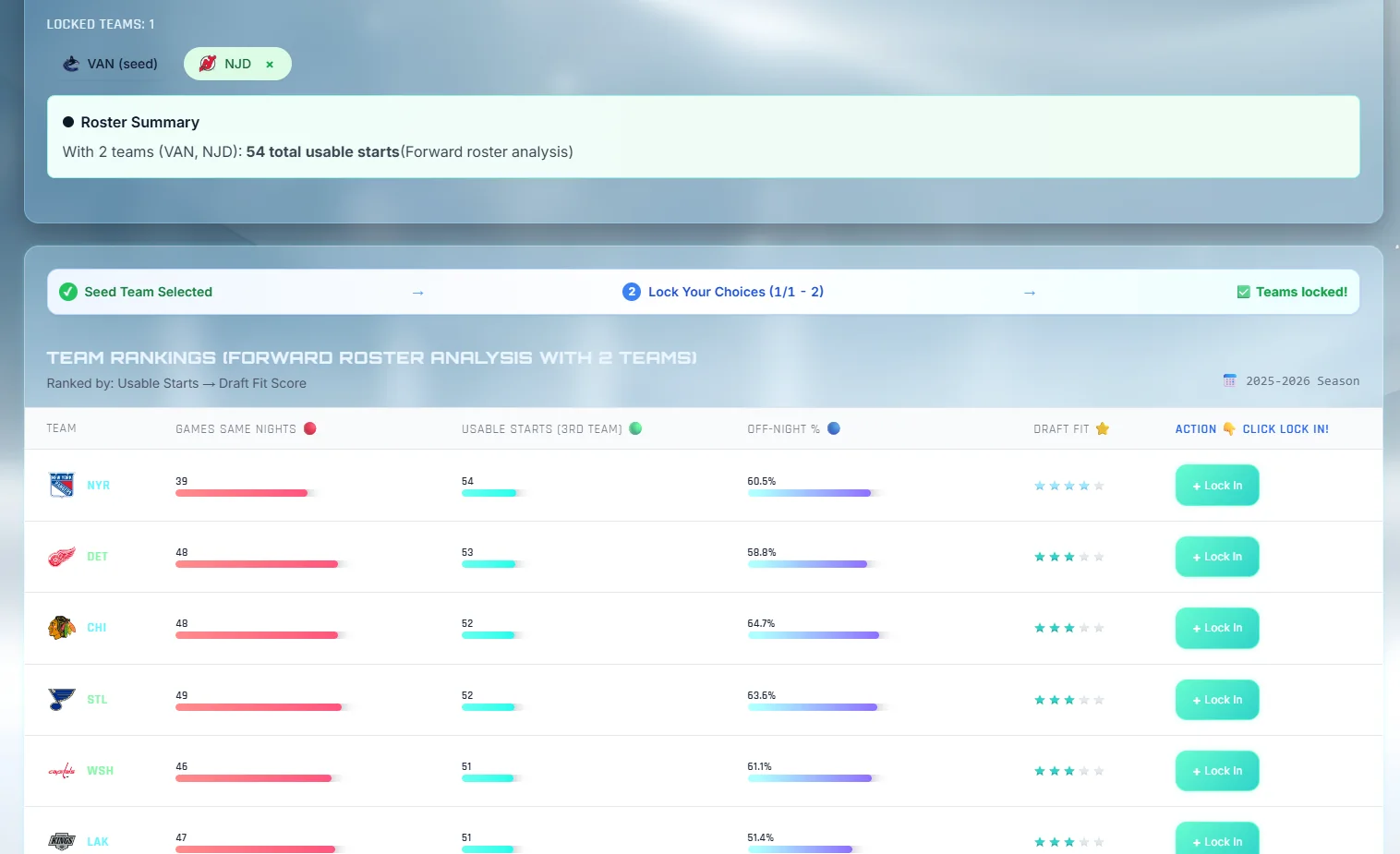
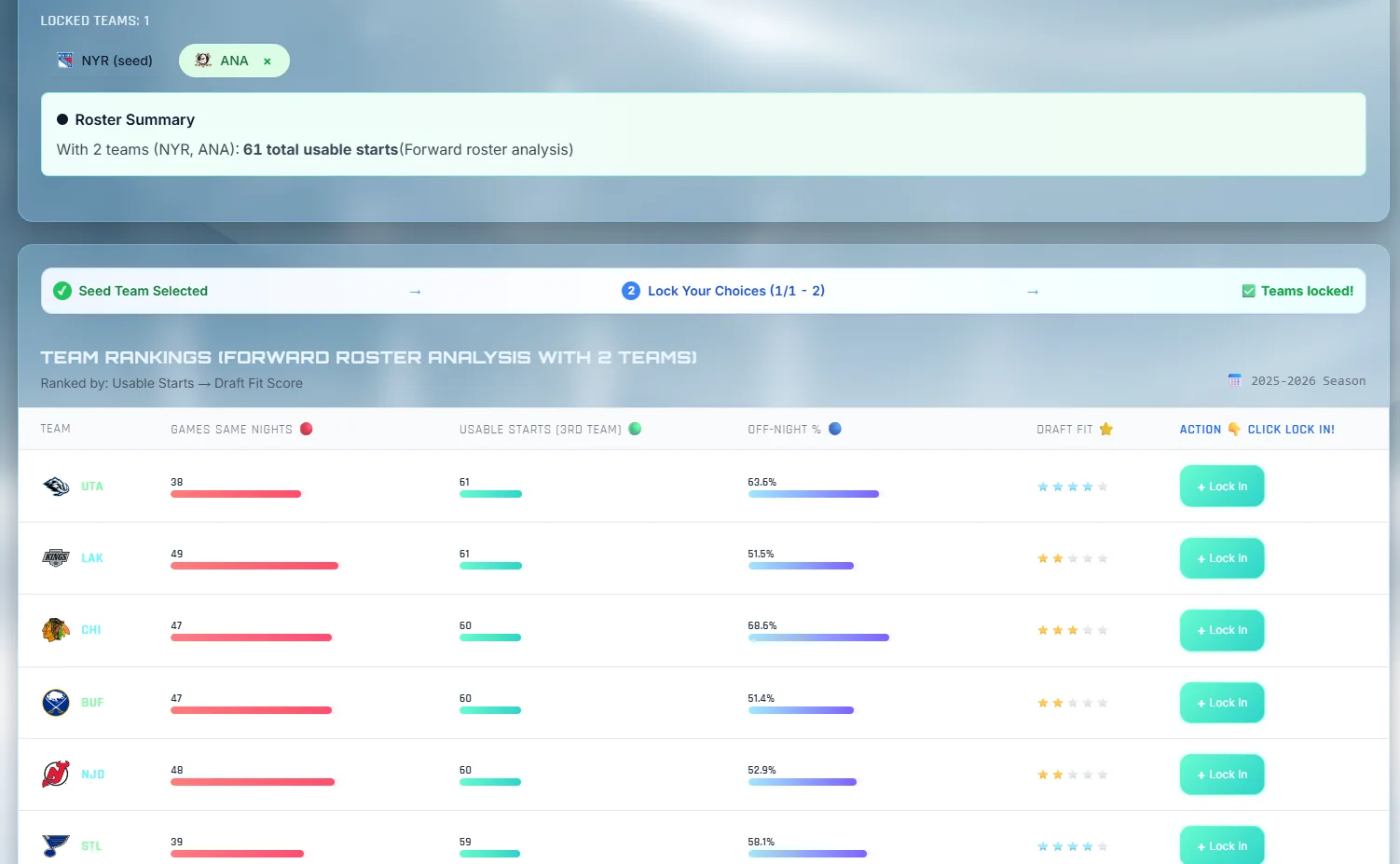
The complement analysis lights up here. With Pettersson and Hischier from VAN and NJD, Trochek was a perfect choice according to the complement analysis tool and slots perfectly into the schedule, maximizing games from that third center slot. This is pure Zero Bench optimization paying dividends.
Pick 104: Rickard Rakell (C/LW/RW, PIT)
Blue playoff team with tri-positional eligibility. When you need lineup flexibility during championship weeks, Rakell can slide into whatever slot is open. Schedule math over pure talent.
Pick 113: Shayne Gostisbehere (D, CAR)
Power play points from a playoff team. Carolina's championship schedule plus Ghost's offensive upside makes this a classic mid-round Zero Bench selection.
Rounds 12-16: Loading the Championship Arsenal
Pick 128: Troy Terry (RW, ANA)
Complement analysis strikes again. Terry fits perfectly into the schedule puzzle, giving me right wing depth when my other players are off.
Pick 137: William Eklund (LW, SJS)
Another complement analysis special. Eklund fills schedule gaps at left wing while providing young upside on a team with favorable game distribution.
Pick 152: Lukas Dostal (G, ANA)
Off-night specialist. Dostal plays when other goalies sit, perfect for streaming optimization and championship roster construction.
Pick 161: Sam Rinzel (D, CHI)
Cyan team with massive breakout potential. If Rinzel clicks, you've got a championship difference-maker. If not, Chicago's schedule still provides value.
Pick 176: Karel Vejmelka (G, UTA)
The complement analysis showed this as the perfect third goalie. Already having Shesterkin (NYR) and Dostal (ANA), Vejmelka slots into the exact schedule gaps my other goalies leave, maximizing starts from the position. With the Mammoth moving on from Ingram, Veggie looks even more likely to get volume on an up and coming team with a great off-night schedule.
Pick 185: Andrei Kuzmenko (LW/RW, LA)
Here's the streaming edge in action. LA starts with back-to-backs before many teams play their first game. Draft Kuzmenko, bank those early streams, then pivot to someone else. Championship preparation starts in week one.
The Final Tally
This roster demonstrates Zero Bench philosophy in action: elite talent anchored by championship-optimized role players, position flexibility where it matters, and a goalie rotation designed for maximum starts. While opponents debate projections, this team is engineered for the games that decide leagues.
Final Picks: The Streaming Edge
Target teams with early back-to-backs (LA's opening week) to "bank" streaming games and stay ahead on weekly moves. Front-loading streams keeps you playing from ahead all season.
Your Championship Blueprint
Different Goals, Different Colors
If you just want to make playoffs, target Green teams - solid regular season production will get you there safely. But we're not here for participation trophies. We're championship-or-bust degenerates who understand that second place is first loser.
The Championship Obsession
- Set your playoff weeks in the tool - colors update based on YOUR league's championship schedule
- Draft by color priority - Cyan first, then Blue/Green, avoid Red unless generational
- Use complement analysis at each pick to prevent position conflicts
- Target early back-to-backs for streaming advantages
- Think championship first - regular season is just qualifying
This isn't about having a nice, balanced roster. This is about engineering a machine that destroys the competition when money changes hands. While your opponents are content with solid seasons, you're building for March madness in the fantasy hockey world.
The Zero Bench Advantage
The core tools that make championship-level schedule optimization possible are live at crackedicehockey.com. Position stack calculator, color-coded team tiers, and complement analysis that turns draft strategy from guesswork into mathematical precision.
Zero Bench isn't about having a better regular season. It's about engineering a roster that peaks when everyone else's crumbles under schedule conflicts.
While your league mates are googling "best week 23 streamers" in desperation during championship week, you'll be starting a full lineup of players whose schedules you optimized months ago. That's not luck - that's championship-level preparation meeting mathematical precision.
Your opponents are drafting for September. You're drafting for March. That's the difference between making playoffs and winning them.